

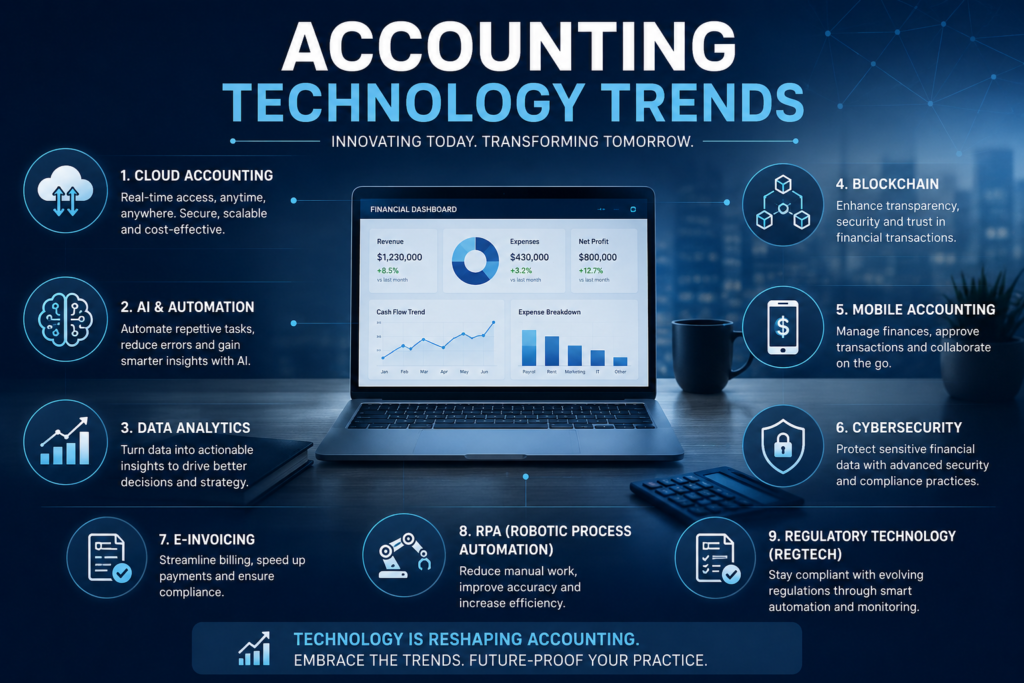
The rise of Artificial Intelligence is one of the most powerful drivers behind modern accounting technology trends, and it is fundamentally changing how systems process and analyze financial data. Traditional accounting methods depended heavily on manual data entry, human calculations, and time-consuming verification processes, which often caused delays and errors. AI-powered systems now automate these processes, and accountants and finance professionals handle large volumes of data with greater speed, accuracy, and consistency. This shift does not only improve efficiency but also redefines the overall role of accounting in business decision-making.
AI is also enabling predictive capabilities in finance, which means businesses can now forecast trends, detect anomalies, and identify potential risks before they become major issues. Machine learning algorithms continuously learn from financial data, improving their accuracy over time and supporting smarter financial planning. As a result, accounting professionals are moving away from repetitive tasks and focusing more on analysis, strategy, and advisory roles. This transformation shows how deeply accounting technology trends are influencing the future of the finance industry.
Cloud-Based Accounting Systems and Integration
Cloud-based systems are one of the most important accounting technology trends, and they have completely changed how businesses store, access, and manage financial data. Instead of relying on traditional desktop software or physical records, businesses now use cloud platforms that allow them to access accounting information in real time from anywhere in the world. This flexibility makes financial management more efficient, especially for companies with remote teams or multiple branches. It also reduces dependency on manual updates because cloud systems automatically sync and store data securely.
Another major advantage of cloud accounting is its ability to integrate with other business tools such as payroll systems, CRM platforms, and inventory management software. This integration creates a unified financial ecosystem where data flows seamlessly between departments, reducing duplication and improving accuracy. It also allows businesses to generate real-time financial reports, which helps decision-makers respond quickly to market changes. As cloud adoption continues to grow, it is becoming a core part of modern accounting technology trends, enabling smarter, faster, and more connected financial operations.
Automation and Robotic Process Automation (RPA)
Automation and Robotic Process Automation (RPA) are transforming the accounting field by handling repetitive and time-consuming tasks with minimal human involvement. As part of evolving accounting technology trends, organizations now widely use RPA tools for processes like invoice generation, data entry, bank reconciliations, and payroll processing. These systems follow predefined rules to complete tasks quickly and accurately and significantly reduce the chances of human error. This allows accounting teams to focus more on analysis and decision-making instead of routine operational work.
Beyond basic task automation, RPA is also improving workflow efficiency across entire finance departments. By connecting different accounting systems and applications, it ensures that data moves smoothly without manual intervention. This not only speeds up financial reporting cycles but also enhances compliance by maintaining consistent records across all platforms. As businesses continue to adopt digital solutions, RPA is becoming a key pillar in modern accounting technology trends, helping organizations save time, reduce costs, and improve overall productivity.
Data Analytics and Real-Time Financial Reporting
Data analytics has become a central part of modern accounting technology trends, allowing businesses to turn raw financial data into meaningful insights. Instead of simply recording transactions, companies now analyze patterns, track performance, and identify financial opportunities using advanced analytics tools. This shift helps organizations understand where money is being spent, how revenue is generated, and what areas need improvement. As a result, accounting is no longer just about reporting history but also about shaping future business decisions.
Real-time financial reporting is another major advancement that comes with data analytics integration. Businesses can now access updated financial statements instantly, rather than waiting for monthly or quarterly reports. This improves decision-making speed and helps companies respond quickly to market changes or financial risks. Real-time dashboards also provide a clear view of cash flow, profitability, and expenses, making financial management more transparent and efficient. Together, analytics and real-time reporting are strengthening the foundation of modern accounting technology trends by making finance more proactive and insight-driven.
Blockchain and Secure Financial Transactions
Blockchain technology is emerging as one of the most secure and transparent innovations within modern accounting technology trends. It works as a decentralized digital ledger where every financial transaction is recorded in a way that cannot be easily altered or deleted. This creates a high level of trust and transparency, which is especially important for auditing, compliance, and financial reporting. By removing the need for intermediaries, blockchain also reduces the risk of fraud and improves the overall integrity of financial data.
In addition to security, blockchain is improving the speed and accuracy of financial transactions across global systems. Businesses operating internationally benefit from faster cross-border payments and reduced transaction costs, as blockchain eliminates many traditional banking delays. It also allows real-time verification of financial records, which simplifies auditing processes and enhances accountability. As adoption increases, blockchain is expected to play a major role in strengthening trust and efficiency in future accounting technology trends.
Cybersecurity and Data Protection in Accounting Tech
Cybersecurity has become a critical part of modern accounting technology trends because financial data is one of the most sensitive and valuable assets for any organization. As accounting systems move to cloud platforms and digital networks, the risk of cyberattacks, data breaches, and unauthorized access also increases. To address these challenges, companies are investing heavily in advanced security systems such as encryption, multi-factor authentication, and continuous monitoring tools. These measures help ensure that financial information remains safe, accurate, and protected from external threats.
At the same time, data protection regulations are becoming stricter, forcing organizations to adopt stronger compliance practices. Accounting systems now include built-in security features that track user activity, detect suspicious behavior, and automatically alert administrators in case of unusual access patterns. This not only improves security but also builds trust with clients and stakeholders who rely on accurate financial reporting. As digital finance continues to expand, cybersecurity remains a foundational element of evolving accounting technology trends, ensuring that innovation does not come at the cost of safety.
Future of Accounting Jobs and Skill Shifts
The future of accounting is being reshaped significantly by ongoing accounting technology trends, leading to a major shift in the skills and roles required in the industry. Traditional tasks such as data entry, bookkeeping, and basic reconciliations are increasingly automated, reducing the demand for purely manual accounting roles. Instead, professionals are expected to develop stronger analytical, technological, and strategic thinking skills to stay relevant in a digital-first financial environment. This evolution is turning accountants into financial advisors who focus more on interpretation and decision-making rather than routine processing.
At the same time, new job roles are emerging that combine finance with technology, such as data analysts, financial technology specialists, and AI-driven audit professionals. Employers now prioritize skills in cloud accounting systems, data analytics tools, and automation platforms. Continuous learning has become essential, as professionals must adapt to rapidly changing financial technologies. These changes highlight how deeply accounting technology trends are influencing career paths, creating a more dynamic, tech-oriented future for the accounting profession.
Conclusion
The evolution of accounting technology trends is clearly transforming the finance industry into a more intelligent, automated, and data-driven ecosystem. From Artificial Intelligence and cloud-based systems to automation, blockchain, and advanced analytics, every innovation is helping businesses improve accuracy, efficiency, and decision-making speed. These technologies are not only simplifying complex accounting processes but also redefining how financial professionals work and deliver value in modern organizations.
As these trends continue to develop, companies that adapt early will gain a strong competitive advantage through better financial control and faster insights. At the same time, accounting professionals must upgrade their skills to match this digital transformation. The future of accounting is no longer limited to traditional number-crunching—it is becoming a strategic, technology-powered discipline that plays a key role in business growth and innovation.
FAQs
What are accounting technology trends?
Accounting technology trends refer to the latest digital innovations such as AI, cloud computing, automation, and data analytics that are transforming how financial data is recorded, processed, and analyzed in modern businesses.
Why is AI important in accounting?
AI is important because it automates repetitive tasks, reduces human error, and provides predictive financial insights that help businesses make faster and smarter decisions.
How does cloud accounting help businesses?
Cloud accounting allows businesses to access financial data in real time from anywhere, improves collaboration, and ensures secure and automatic data updates across systems.
Will technology replace accountants in the future?
Technology will not fully replace accountants but will change their roles. Accountants will focus more on analysis, strategy, and advisory work while automation handles routine tasks.
For more tech updates Visit: Techsif